
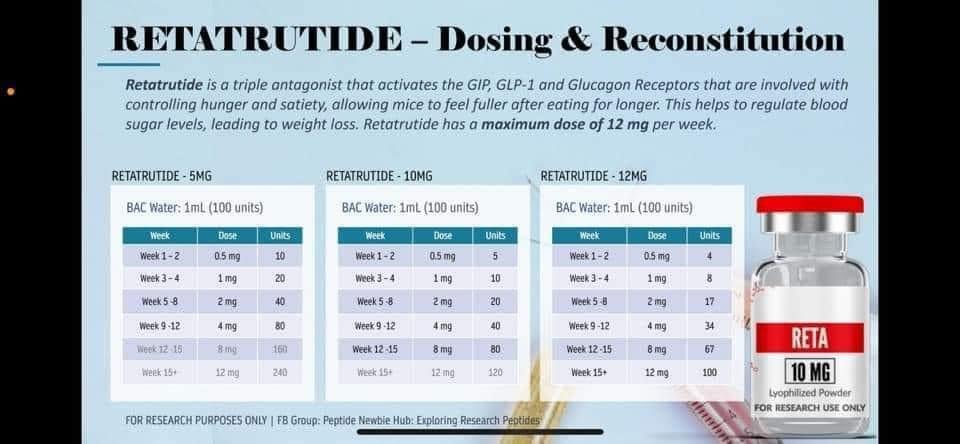
Retatrutide is supplied as a lyophilized powder intended for research purposes and must be reconstituted with either bacteriostatic water or sterile water.
Bacteriostatic water, which contains 0.9% benzyl alcohol, is preferred for reconstitution because it inhibits bacterial growth, allowing the peptide to remain stable for up to four weeks when refrigerated properly at 36 to 46 degrees F (2 to 8 degrees C) [13].
In contrast, when sterile water is used, the peptide’s stability lasts only 24 hours.
Researchers typically follow these steps for the reconstitution process:
- Assemble all necessary materials and let the retatrutide and bacteriostatic water vials come to room temperature, avoiding exposure to heat or sunlight.
- Clean the rubber stoppers of the vials with alcohol swabs to prevent contamination.
- Use a sterile syringe to draw air and inject it into the bacteriostatic water vial to facilitate the withdrawal of the liquid.
- Withdraw the required amount of water and carefully inject it into the retatrutide vial, directing the stream along the vial’s side to prevent foam formation.
- If sonication equipment is available, use it to speed up the dissolution of the powder; otherwise, allow the powder to dissolve slowly without shaking.
- Check the solution for clarity, and discard it if any turbidity or particles are present.
Following this protocol ensures proper reconstitution of retatrutide for research while maintaining accuracy and professionalism.
