
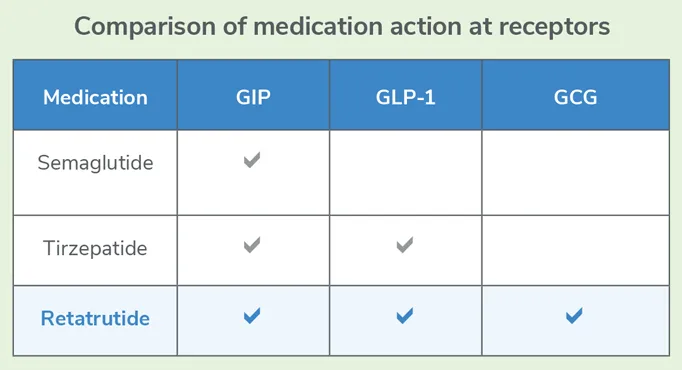
Outlined below you can find several key clinical trials that have demonstrated the efficacy and potential research applications of retatrutide.
Retatrutide and Weight Loss Research
As of 2024, phase 3 trials within the TRIUMPH program are in progress, exploring retatrutide’s potential for weight loss. Earlier phase 1 and phase 2 studies have shown promising results, indicating that the peptide could lead to up to a 24% reduction in body weight from baseline.
The initial human trial of retatrutide, a proof-of-concept study, took place in Singapore in 2019. This phase 1 trial involved 47 participants who were administered six different dose levels, ranging from 0.1 mg to 6 mg weekly. The study suggested potential positive effects on appetite, food intake, and other metabolic markers, alongside a favorable safety profile [4].
Following this, a larger phase 2 trial was conducted, lasting 48 weeks and involving 338 non-diabetic adults with overweight and obesity. Participants received varying doses of retatrutide, and the trial demonstrated a dose-dependent reduction in weight and improvement in cardiometabolic risk factors. Key findings included [7]:
- An 8.7% weight reduction in the 1 mg dose group
- A 17.1% weight reduction in the 4 mg group
- A 22.8% reduction in the 8 mg group
- A 24.2% reduction in the 12 mg group
All participants who received either 8 mg or 12 mg of retatrutide weekly experienced at least a 5% reduction in their initial body weight. In addition, significant reductions were observed in waist circumference, blood pressure, glycated hemoglobin, fasting glucose, insulin levels, and lipid levels, excluding HDL cholesterol.
Retatrutide and Type 2 Diabetes Research
Eli Lilly is conducting ongoing research on retatrutide’s potential to manage glycemic control and obesity in individuals with type 2 diabetes (T2D) as part of the phase 3 TRIUMPH clinical trials.
Earlier trials, including phase 1b and phase 2 studies, have shown encouraging outcomes. In a 12-week phase 1b trial, 72 adults aged 20-70 with T2D and baseline A1c levels between 7.0% and 10.5% were treated with either retatrutide, dulaglutide (a GLP-1 agonist approved by the FDA), or placebo.
By week 12, those receiving the highest dose of retatrutide (12 mg weekly) saw a significant decrease in A1c of up to 1.6% and a weight reduction of up to 19.7 pounds (8.96 kg). These results were markedly better than those seen with both dulaglutide and placebo [12].
A subsequent 36-week phase 2 trial involved 281 T2D patients receiving up to 12 mg of retatrutide weekly. Key results include [6]:
- Participants in the 12 mg group experienced a significant HbA1c reduction of 2.02% (22.07 mmol/mol) at 24 weeks and 2.16% (23.59 mmol/mol) at 36 weeks, compared to negligible change (0.01%) in the placebo group after 24 weeks.
- By the conclusion of the 36-week trial, weight loss was dose-dependent, with the 12 mg group losing 16.94% of their body weight, compared to a 3.00% reduction in the placebo group.
- Additionally, retatrutide treatment led to improved lipid profiles, including decreases in triglycerides and non-HDL cholesterol, with the 12 mg group showing significant improvement at 36 weeks compared to both baseline and placebo.
